Synopsis
‘Reminiscent of Edna O’Brien, with shades too of Jean Rhys.’ – The Irish Times
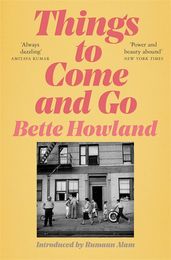
Things to Come and Go showcases the incomparable talent of Bette Howland in three novellas of stunning power, beauty, and sustaining humour.
‘Birds of a Feather’ is a daughter’s story of her extended, first-generation family, the ‘big, brassy yak-yakking Abarbanels’. Esti, a merciless, astute observer, recalls growing up amid (the confusions and difficulties of) their history, quarrels, judgements, noisy love and inescapable bonds of blood.
In ‘The Old Wheeze’ a single mother in her twenties returns to her sunless apartment after a date at the ballet. Shifting between four viewpoints – the young woman, the older professor who took her out, her son, and her son’s babysitter – the story masterfully captures the impossibility of liberating ourselves from the self.
In ‘The Life You Gave Me’, a woman at the midpoint of life is called to her father’s sickbed. A lament for all that is forever unsaid and unsayable, the story is ‘an anguished meditation on growing up, growing old and being left behind, a complaint against time.’ (The New York Times)
First published in 1984, Things to Come and Go, Bette Howland’s final book, is a collection of haunting urgency about arrivals and departures, and the private, insoluble dramas in the lives of three women.
With an introduction by Rumaan Alam, bestselling author of Leave the World Behind.
Details
Reviews
“There is being seen, and then there is seeing. There is no seeing like Bette Howland's. On every page, catching the narrator's every glance, are observations rich in detail and delight—honest, acerbic, alert, and always dazzling in their inventiveness and wry, hard-edged wisdom.”Amitava Kumar
“One of the significant writers of her generation”Saul Bellow
“Howland's striking prose breathes life into the everyday, the domestic world sung with a lyrical note . . . reminiscent of Edna O'Brien, with shades too of Jea Rhys.”Sarah Gilmartin, Irish Times
“Beneath the bright patter and eye-catching descriptions, each story has sadness at its core . . . a flood of energetic storytelling.”Marion Winik, Washington Post